
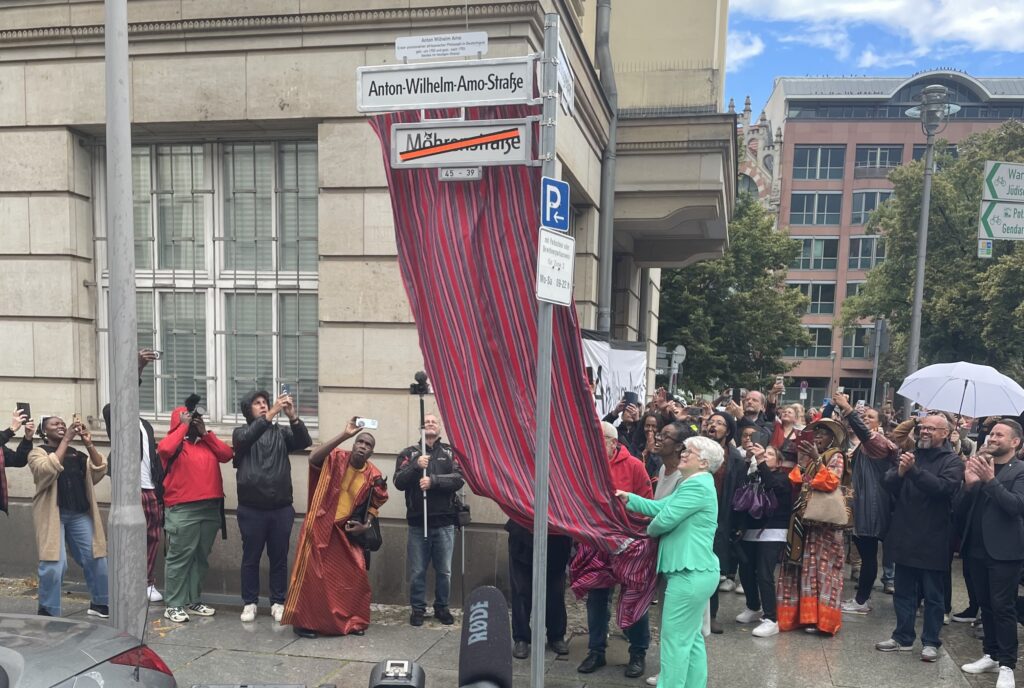
Conversation with Tahir Della of ISD e.V. and glokal e.V.
What does the renaming of M*Street mean for decolonial civil society?
After more than 30 years of advocacy by Black, Afro-diasporic, and solidarity-based initiatives, the moment had finally arrived: M*Straße is now officially named Anton-Wilhelm-Amo-Straße. With this decision, Berlin honors Anton-Wilhelm-Amo, the first known philosopher and legal scholar of African descent in 18th-century Germany, and sends a visible message against racism and colonial legacies in public spaces.
Why was there opposition to the renaming, and who was behind it?
Opposition to the renaming of M*Straße in Berlin came from a wide variety of quarters—and it clearly reflects just how deeply colonial legacies and everyday racism are still entrenched in Germany.
Both residents and business owners were opposed to the renaming—either out of convenience or fear of costs (e.g., changing addresses and business documents). Behind this often lies the desire that changes aimed at combating racism should “not affect one’s own life”—in other words, classic resistance to necessary but inconvenient transformation. In addition, however, there were historians who fueled doubts about the discriminatory impact of the external designation “M*” and also downplayed Amo’s role. They also never tired of claiming that the entire process was non-transparent and undemocratic. In doing so, they ignored the fact that all legal authorities were tasked with examining whether the renaming was arbitrary—and therefore unlawful—or not.
The district has also organized numerous events to keep people informed about the status of the process and to give residents the opportunity to participate in it.
Who was Anton-Wilhelm Amo?
Anton Wilhelm Amo (c. 1703–after 1753) was the first known African philosopher at European universities. As a child, he was enslaved in what is now Ghana (then part of the so-called “Gold Coast”) and taken to Germany, where he was later “given” to a prince and baptized. Despite this colonial violence, he fought for an education and became a highly respected scholar in Halle and Wittenberg. Amo taught philosophy in Halle and Jena, wrote important works on the philosophy of law and epistemology, and criticized, among other things, the institution of slavery. His life exemplifies resistance, self-assertion, and intellectual greatness in the face of colonial oppression—and makes him a central symbolic figure for anti-racist remembrance culture in Germany.
What happens next? What’s coming up?
As part of the street renaming initiative, the next step—the renaming of Nettelbeckplatz—is scheduled for October of this year. Joachim Christian Nettelbeck (1738–1824) was a Prussian sailor who was glorified as a “patriotic hero” in the 19th century, but who is also tainted by his colonial-racist writings and his involvement in the slave trade. And we will be unveiling three more informational plaques in the African Quarter for the streets that have already been renamed there: Anna-Mungunda-Allee, Maji-Maji-Allee, and Manga-Bell-Platz.
The renaming of M*Street marks not the end, but the beginning of a necessary process of decolonization. It is a visible sign that colonial continuities in our society must be critically examined. Decolonization, however, must not be limited to symbolic acts; rather, it must be understood as a cross-cutting issue that encompasses politics, education, culture, academia, the economy, and everyday life in equal measure.
Only when colonial power structures are examined and dismantled in all areas can genuine social change take place.